|
|

|
|||||||||||||||||||||||||
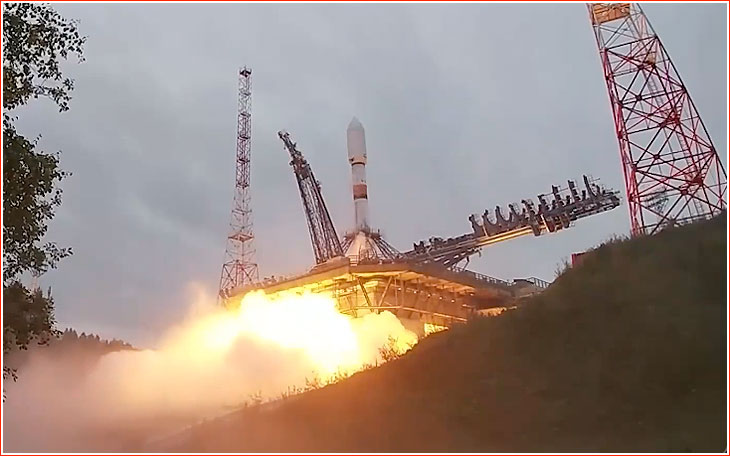
Soyuz rocket delivers fresh GLONASS navsat A Soyuz-2-1b rocket delivered a classified payload from a military launch site in Plesetsk in the early hours of Aug. 24, 2026, just a day after reports of drones heading toward the launch site.
Aug. 24, 2026, mission at a glance:
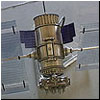
In mid-July 2026, Russian authorities announced air and sea navigation restrictions that matched previous GLONASS missions. The window extended from July 16 to July 23, 2026, but was then cancelled, after possibly serving as a "cover" for the second 16-satellite batch of Rassvet satellites (INSIDER CONTENT) launched on July 19, 2026. However, similar warnings re-appeared in mid-August 2026, for a period between Aug. 19 and Aug. 30, 2026, this time overlapping with several parallel warnings issued as early as August 8 for drop zones used by an Angara-1.2 rocket, which was presumably scheduled for launch between August 13 and August 27. As before, restricted drop zones used by different launch vehicles were likely designed to complicate Ukrainian targeting of a particular launch site in Plesetsk. However, that measure was then negated somewhat with an announcement by local authorities in the Komi Republic on Aug. 15, 2026, about the closures of Vashka and Zheleznodorozhny impact sites, which covered Udorsky, Knyazhpogostsky and Kortkerossky districts. Theses sites were previously used for launching GLONASS satellites on Soyuz rockets. Unlike previous announcements by the Komi Republic, which would normally identify the launch window, the latest statement, put the launch in the "second half of August," without additional details. By Aug. 21, 2026, the authorities in the Tyumen Region of Russia warned about the planned impact of rocket debris in the Uvatsky District, also only identifying "the second half of August" as the timing of the launch. Third drone attack on Plesetsk? On the evening of Aug. 22, 2026, the administration of the Kargopol District, some 170 kilometers from Plesetsk, cancelled Dzhem 29/SeverROK rock festival due to drone threat, which was followed by eyewitness reports from the Arkhangelsk Region about drone activities. One report, published by Supernova+, described four drones spotted over Kargopol and heading north, presumably toward Plesetsk. There were no reports of impacts or air defense work and no official confirmation of the attack from the Ukrainian military, however the ASTRA publication said that a smoke seen on photos from Mirny (the main residential area of spaceport) indicated an impact somewhere in Plesetsk. The governor of the Arkhangelsk Region Aleksandr Tsibulsky made two announcements about drone threats on the mornings of August 22 and 23, while the Russian military claimed intercepts in the Arkhangelsk Region on the same dates in its evening reports. On August 23, the Mirny administration reported a successful intercept of a "mass drone attack" on the Arkhangelsk Region. If Plesetsk was indeed the target, it would be the third reported attempt to attack the spaceport with a fueled rocket on the pad, after one on Dec. 25, 2025, during the Obzor-R launch countdown and on March 23, 2026, when the first batch of 16 Rassvet satellites (INSIDER CONTENT) was launched. Fresh GLONASS lifts off On the morning of Aug. 24, 2026, the Russian Ministry of Defense reported that its space forces had successfully launched a Soyuz-2-1b rocket with a military spacecraft at 05:40 Moscow Time. The Russian military also confirmed that the payload had reached orbit as planned, that its ground assets had established telemetry communications with the satellite and its onboard systems were functioning as planned. Within 24 hours, the US Space Force cataloged two objects associated with the July 24, 2026, launch that left no doubts that the Soyuz-2 rocket delivered a Fregat space tug with a fresh GLONASS satellite:
That fact was also confirmed by the online re-posts of the official launch announcements by ISS Reshetnev (GLONASS developer) and by NPO Lavochkin (Fregat developer).
|
|

|