|
|
|

|
||||||||||||||||||||||||||
|
Russian lunar missions face new delays The failure of the Luna-25 lander in August 2023 triggered a major re-evaluation of the lunar exploration strategy at Roskosmos, backdropped by the uncertain space budget, a massive brain drain and the complete breakdown of cooperation with the West as a result of the war against Ukraine.
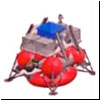
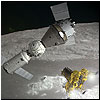
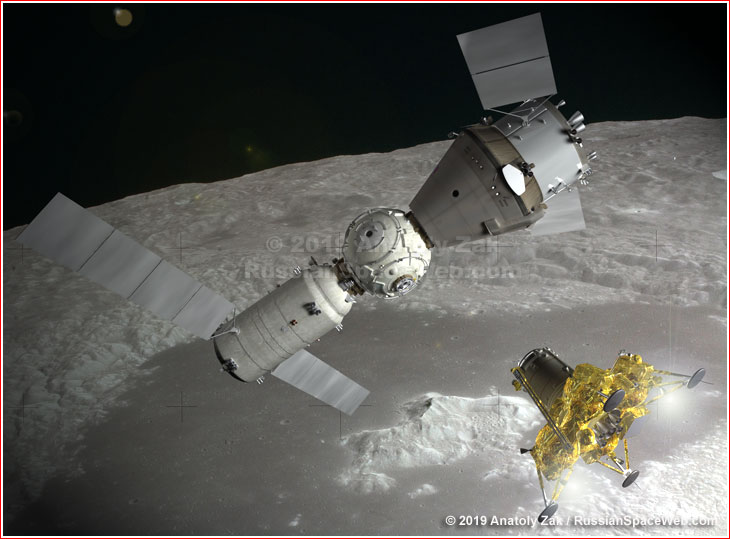
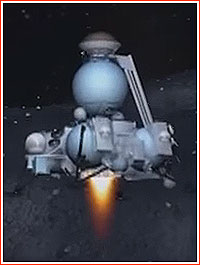
Artist rendering of the Korvet lander approaching a lunar orbital facility. (INSIDER CONTENT)
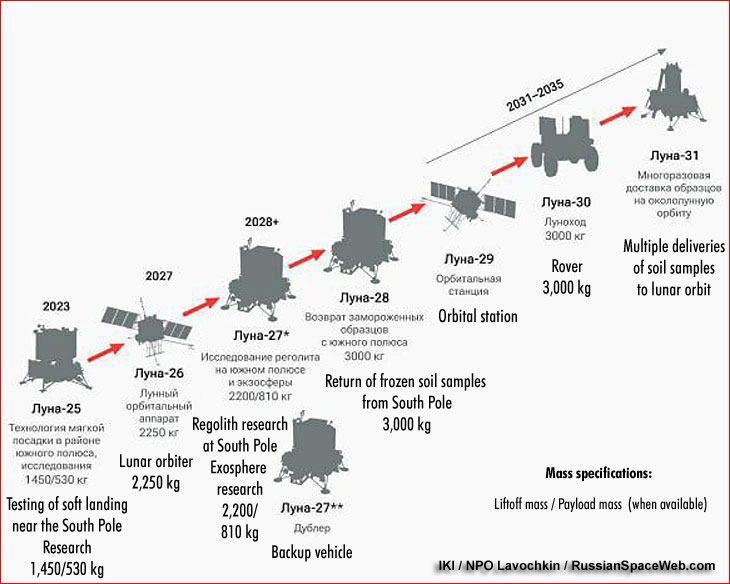
On the heels of the successful but short-lived trip of the Luna-Glob (Luna-25) spacecraft to the lunar orbit in August 2023, Head of Roskosmos Yuri Borisov said that the launch of the Luna-26 (Luna-Resurs Orbiter) spacecraft was planned for 2027, followed by Luna-27 (Luna-Resurs Lander) in 2028 and by Luna-28 (Luna-Grunt) in 2030 or later. Despite being pushed back relative to previous schedules, these dates had to be considered very optimistic given the need for a complete overhaul of these projects in order to replace imported components and instruments, not to mention funding levels in the program. Soon after the loss of the Luna-25 (Luna-Glob) spacecraft, Borisov expressed hope for repeating the mission, while there were also calls for building two flight-worthy Luna-27 landers to increase chances for success of the Luna-Resurs project. According to reports from the International Astronautics Congress, IAC-2023, in October 2023, Russian officials still presented the existing decade-old strategy for lunar exploration, including Luna-26, -27, and -28, but without definitive launch dates for any of these missions pending the review of the Luna-25 failure. At the same time, Borisov was quoted as saying that Roskosmos had been considering moving launch dates for Luna-26 and Luna-27 missions forward in order to accelerate the overall program. In October 2023, NPO Lavochkin, the prime contractor in the Russian robotic exploration program, and the Space Research Institute, IKI, a key developer of scientific experiments in space, released the latest revision of the Russian lunar exploration strategy with robotic spacecraft at the 14th simposium on the exploration of the Solar System at IKI in Moscow:
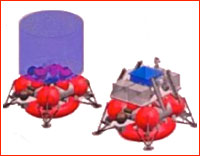
The plan retained the launch date for the next Russian lunar mission — the Luna-26 orbiter — in 2027, despite earlier hopes for accelerating its development. A recent proposal to build the second copy of the failed Luna-25 lander was also rejected due to lack of hardware and contractor support for implementing such a project in reasonable time. Instead, the strategy penciled the next Russian attempt to land a robotic probe on the surface of the Moon for 2028, but added a backup flight version of the lander into the program without a definitive launch date. According to estimates made by the IKI by the end of 2023, the construction of the two similar landers would cost between 30 and 35 percent more than the construction of a single Luna-27 spacecraft. Roskosmos reportedly endorsed the idea, but the extra funding for the development of a flight-worthy dublicate was yet to be apporved before the end of 2023. As stipulated more than decade earlier, the Moon exploration program would then proceed with an attempt to return frozen samples of lunar soil from the South Pole region. The exact date of the mission was no longer specified but it was assumed to be possible no earlier than at the turn of the 2030s. The plan also envisioned the implementation of the previously proposed concepts of a roving vehicle on the Moon, now identified as Luna-30, and the introduction of a robotic shuttle vehicle for multiple deliveries of soil samples from the Moon to the lunar orbit in the first half of the next decade. The latter concept, previously known as Korvet (INSIDER CONTENT), was now identified as Luna-31. It was conceived to operate in conjunction with infrastructure in the lunar orbit, but the 2023 version of the strategy had no indication about the architecture of the Luna-31 project. However, with the assumption that the Luna-26 orbiter would not last long enough to provide communications for lunar missions in the 2030s, the plan also envisioned the launch of another orbiter around 2031 to support the subsequent landers. Interestingly, it was identified as "orbital station" — the term that implies a piloted vehicle. As often before, the latest strategy relied on the development time frames that had never been demonstrated by NPO Lavochkin in comparable projects in the past three decades. In July 2024, Borisov said that Roskosmos had been spending less than seven or eight billion rubles annually on the exploration of the deep space, instead of planned 12-14 billion. Roskosmos adds mission concept to its lunar program
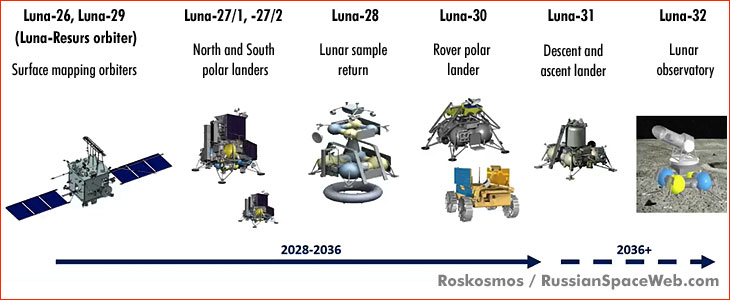
Russian lunar exploration strategy as of December 2025. In April 2025, speaking at the meeting of the BRICS space agencies heads in Brazil, the newly appointed head of Roskosmos Dmitry Bakanov re-confirmed the 2023 roadmap for launching six lunar robotic missions, including the Luna-26 and Luna-29 orbiters, plus the pair of Luna-27 landers, as well as prospective sample return and rover missions, known as Luna-28 and Luna-30 respectively. Bakanov also re-iterated Russian plans to deploy a power station on the surface of the Moon (INSIDER CONTENT) within a joint lunar exploration effort with China. (INSIDER CONTENT) However, no launch dates were cited for any of these missions at the time, hinting at the budgetary and technical uncertainty around the program. Speaking at the general assembly of the Russian Academy of Sciences on May 28, 2025, its president Gennady Krasnikov said that the funding for the new lunar program would start in the course of the year and it would cover seven scientific missions "aimed at the construction of a station on the Moon," as quoted by TASS. In early June 2025, NPO Lavochkin said that the Luna-Resurs-1 (Luna-27) project had been included into the Nauka Federal Project (INSIDER CONTENT) then still under development for the period from 2026 to 2035. (INSIDER CONTENT) According to that document presented at the expanded meeting of the Federation Council for Economic Policy in the same month, 129.7 billion rubles ($1.65 billion) were to be spent on two lunar missions (presumably, the Luna-Resurs orbiter (INSIDER CONTENT) and a lander) by 2030, and a total of 198.1 billion rubles ($2.53 billion) would cover four missions (including Luna-28 and Luna-29) by 2036. In August 2025, Gennady Krasnikov, the Head of the Russian Academy of Sciences, RAN, in an interview with the Izvestiya newspaper once again reiterated the ambitious plans to launch the entire armada of six or seven lunar probes, but, by that time, the launch date for the Luna-26 orbiter had already slipped to 2028, while the pair of Luna-27 landers had drifted to 2029 and 2030. The still-promised lunar sample return missions experienced a respective delay, while the Luna-30 lander with a heavy rover had now moved to the nebulous 2035-2036 time period. RAN updated its public Moon exploration strategy in December 2025 with the addition of the Luna-32 lunar surface observatory to the wish list of missions. The first lunar orbiter in the program remained on schedule for launch in 2028, followed by the four missions up to Luna-30 loosely promised to launch before 2036 but without concrete launch dates. The Luna-31 and Luna-32 missions fell under a "dotted timeline" extending beyond 2036. Russian space science program faces widening years-long gap In the last week of January 2026, the Bauman Technical University in Moscow held a traditional Korolev's Readings, where Roskosmos presented its timeline for 14 space science projects officially under development, including six lunar robotic missions, five space observatories, three geophysics spacecraft and a Venera probe. Most notably, this schedule did not expect a single scientific mission to reach the launch pad in nearly three years. Given the probability of various technical challenges to such complex spacecraft, the gap in launches of Russian science missions could easily extend into the 2030s, even if all promised money provided as scheduled. According to Roskosmos, the Luna-26 orbiter remained the first priority, but its launch date was now clarified as the late 2028, essentially making a delay at least into 2029 practically inevitable. Next, two lunar landers (Luna-27A and -27B) were expected to fly in year-long intervals, which for the spacecraft of this complexity was nowhere near realistic. For a credible schedule, based on recent performance and the capabilities of the developer, the planners would have allocate at least four-five years between each mission, but, it, obviously would be politically suicidal. For example, it will be at least five years between the failed attempt to launch the Luna-25 lander and the launch of a less-complex Luna-26 orbiter in 2028, if it launched as promised in 2028. Even though, there was a considerable commonality in the design of the Luna-27A and Luna-28B landers, scheduled for launch in 2028 and 2029, their prime developer NPO Lavochkin, would typically need several years between the launches of the far less complex and practically identical Elektro-L weather satellites. The second copy of the Luna-26 spacecraft, modified to serve as a relay orbiter, was moved forward in the timeline to late 2032 in order to support two surface missions in the 2030s, but the spacecraft so far retained designation Luna-29 from the old revision of the schedule. Under the latest timeline, it would be followed by the Luna-28 sample return mission in late 2034, probably carrying a miniature rover, which could select soil samples, while communicating with the Earth via Luna-29 pre-deployed in the lunar orbit. Next, according to the schedule, the Luna-30 lander would deliver a pair of mid-size rovers to the Moon in late 2036. Obviously, all missions with launch dates in mid-2030s were pure paper concepts, completely depending on funding in the next decade. Astrophysics missions Russia's space-based astronomy and astrophysics program looked even more bleak, despite an addition of two observatories in what had to be qualified as a wish list rather than a solid program. According to the latest schedule, the first to go, as early as 2031, was the "almost finished" Spektr-UF ultraviolet telescope, which had been in the assembly shop for the past decade waiting for the replacement of its foreign components. The newly added Spektr-RGN X-ray observatory, whose launch was "front loaded" into the schedule at the end of 2032, apparently thanks to an opportunity for using available spare parts, infrastructure and experience from the already flying Spektr-RG telescope. In the meantime, the most complex and expensive project in the program — Spektr-M Millimetron observatory — was now moved to the end of 2035, which was beyond the farthest 10-year horizon of the Russian budget projection. Even further ended up the Venera-D project aiming landing on Venus, Russia's lone planetary exploration mission, which formally survived the cuts, but it was not expected to fly before 2036, a largely symbolic date. All of these missions, plus a trio of Rezonans space weather satellites and the Arka Sun monitor, were the responsibility of NPO Lavochkin, which in the post-Soviet period had not come anywhere close to demonstrating a kind of launch tempo that would be required by the latest schedule even with all its remote launch dates. Several other proposed missions, which were long featured in the Russian exploration plans and promoted in the official press had disappeared from the program. The schedule no longer listed any Mars or Phobos exploration probes, no comet or asteroid visitors, no attempts to send a mission to Jupiter and no plans to explore the Sun, which were all intermittently present in previous similar documents.
|
|

|